Predictive Analytics for Trade Show Leads

Predictive Analytics for Trade Show Leads
Predictive analytics is transforming trade show success by helping businesses focus on high-value leads, improve ROI, and optimize resources.
Here’s the bottom line:
- Trade show spend is rising: Exhibitors spent an average of $1.4 million in 2023, a 70% increase from the previous year.
- Data-driven strategies deliver results: Companies using predictive analytics report a 20% boost in ROI.
- Key benefits: Better lead targeting, smarter resource allocation, and clear ROI measurement.
Predictive analytics uses historical data and AI to prioritize leads, personalize attendee interactions, and adjust strategies in real time. Tools like Eventiqs simplify this process by offering features like automated lead scoring, attendee interest tracking, and CRM integrations.
For exhibitors, this means less wasted effort, higher conversions, and actionable insights to plan future events effectively.
Data Sources and Techniques for Trade Show Lead Targeting
To succeed with predictive analytics, you need reliable data from diverse sources and smart techniques to turn that data into actionable insights. Put simply, the predictions you make are only as good as the information you provide. That’s why it’s crucial to know where to gather data and how to analyze it effectively. Below, we’ll explore the key data sources and methods that form the foundation of effective lead targeting at trade shows.
Key Data Sources for Predictive Analytics
Attendee Demographics and Registration Data are the starting point for any predictive model. This includes details like job titles, company size, industry, geographic location, and registration preferences. While event organizers often provide basic attendee lists, the real value comes from enriching this data with other sources. For instance, companies that integrate marketing and sales data report up to a 15% increase in revenue growth, showing the power of comprehensive data collection.
Booth Interactions and Engagement Metrics offer real-time insights into attendee behavior. These metrics include badge scans, time spent at your booth, materials downloaded, demo requests, and even the topics discussed during conversations. By using digital lead capture tools, you can track these interactions and identify which prospects are most interested. In fact, companies using digital lead capture tools report conversion rates that are three times higher than those relying on traditional methods.
Social Media Activity and Digital Footprints can reveal a lot about attendees even before they step foot in your booth. Platforms like LinkedIn and Twitter, as well as company news and content consumption patterns, provide clues about their interests and challenges. For instance, one B2B SaaS company saw a 138% jump in SQLs after shifting its focus from general traffic to targeting transactional keywords. This example highlights how behavioral data can sharpen your lead targeting efforts.
Historical Event Performance Data is essential for building predictive models. Metrics like past attendee conversion rates, average sales cycle lengths, deal sizes, and customer lifetime values help you identify recurring patterns. This historical data gives you the context needed to predict which prospects are most likely to convert at future events.
CRM and Sales Data Integration ties trade show interactions to your existing customer data. This includes purchase histories, email engagement, website activity, and previous sales interactions. By combining historical customer data with real-time event activity, you can create a more complete profile of each prospect.
As W. Edwards Deming famously said, "Without data, you're just another person with an opinion."
It’s equally important that your data collection complies with privacy regulations like GDPR. Always obtain explicit consent before analyzing personal information.
Main Predictive Techniques for Lead Targeting
Once you’ve gathered the right data, predictive techniques can help you zero in on the most promising leads.
Lead Scoring Models assign numerical values to prospects based on their likelihood to convert. These models analyze factors like demographics, engagement history, and behavioral patterns to prioritize leads. By focusing on leads that align with your ideal customer profile, businesses have reported 73% higher conversion rates.
Behavioral Analysis and Pattern Recognition digs into how attendees interact with your content, booth, and other touchpoints. This technique identifies subtle behaviors, like attending specific sessions or asking about particular products, that signal buying intent. With AI, you can process large datasets quickly, uncovering patterns that might otherwise go unnoticed and improving your ability to predict lead conversions.
Lookalike Modeling focuses on finding trade show attendees who resemble your best existing customers. By analyzing the traits of your most valuable clients - such as company size, challenges, and behavioral patterns - you can identify similar prospects. This model gets smarter over time, refining its accuracy as it learns from new interactions and outcomes.
Real-Time Predictive Scoring updates lead priorities dynamically as new information comes in during the event. Unlike static pre-show scoring, this technique adjusts predictions based on real-time actions like booth visits, session attendance, app usage, and networking activity. This allows your team to respond quickly to high-potential leads and focus their efforts where it matters most.
To make these techniques work, continuous testing and updates are essential. Predictive models need to evolve with new data to account for changing customer behaviors and market trends.
Data Integration Requirements
For predictive analytics to run smoothly, your systems must work together seamlessly. Here’s how to make that happen:
CRM System Synchronization is key to keeping your predictive tools connected to your existing customer databases. Platforms like Salesforce and HubSpot should sync automatically, providing real-time updates on lead status, interaction history, and conversions. This eliminates manual data entry and ensures nothing falls through the cracks.
Mobile App and Digital Platform Connectivity captures attendee activity across all digital touchpoints. Whether it’s session check-ins, content downloads, or survey responses, these interactions should feed directly into your predictive models. Automating data collection not only saves time but also reduces errors compared to manual processes.
API Integration and Middleware Solutions help bridge gaps between systems that don’t naturally communicate. Middleware can translate data formats and ensure compatibility between your current tools and new analytics platforms. Assess your tech stack to identify and resolve any potential compatibility issues early.
Data Quality and Cleansing Processes ensure that the information flowing through your systems is accurate and consistent. This involves cleaning, standardizing, and validating your data. Clean data is critical, with 78% of businesses reporting that accurate data significantly improves client acquisition and lead conversion.
Real-Time Data Processing Capabilities are essential for keeping your predictive models up to date. Your system must handle large volumes of data without delays, especially during high-traffic events. Testing your setup at smaller events before major trade shows can help you identify and fix any bottlenecks in your data workflows.
By breaking down data silos and creating a centralized repository - where information from IoT devices, badge scanners, CRM systems, and digital platforms is all consolidated - you can eliminate blind spots and improve prediction accuracy.
The ultimate goal is a seamless technology ecosystem where data flows automatically, giving your team real-time insights without the hassle of manual intervention. With reliable integration in place, your predictive techniques can work their magic, helping you make the most of every trade show opportunity.
AI-Powered Platforms for Trade Show Predictive Analytics
AI-powered platforms like Eventiqs bring together data collection and predictive techniques to transform trade show strategies into actionable insights. These tools simplify the complex task of analyzing attendee behavior, predicting lead quality, and fine-tuning strategies in real time.
Unlike basic lead capture tools, modern AI platforms leverage machine learning to sift through massive amounts of attendee data, uncovering patterns that might otherwise go unnoticed. They also provide instant recommendations for sales teams, ensuring smarter decision-making. Eventiqs is a prime example, combining advanced analytics with an intuitive interface to help exhibitors achieve better results.
Eventiqs: Complete Event Intelligence Platform
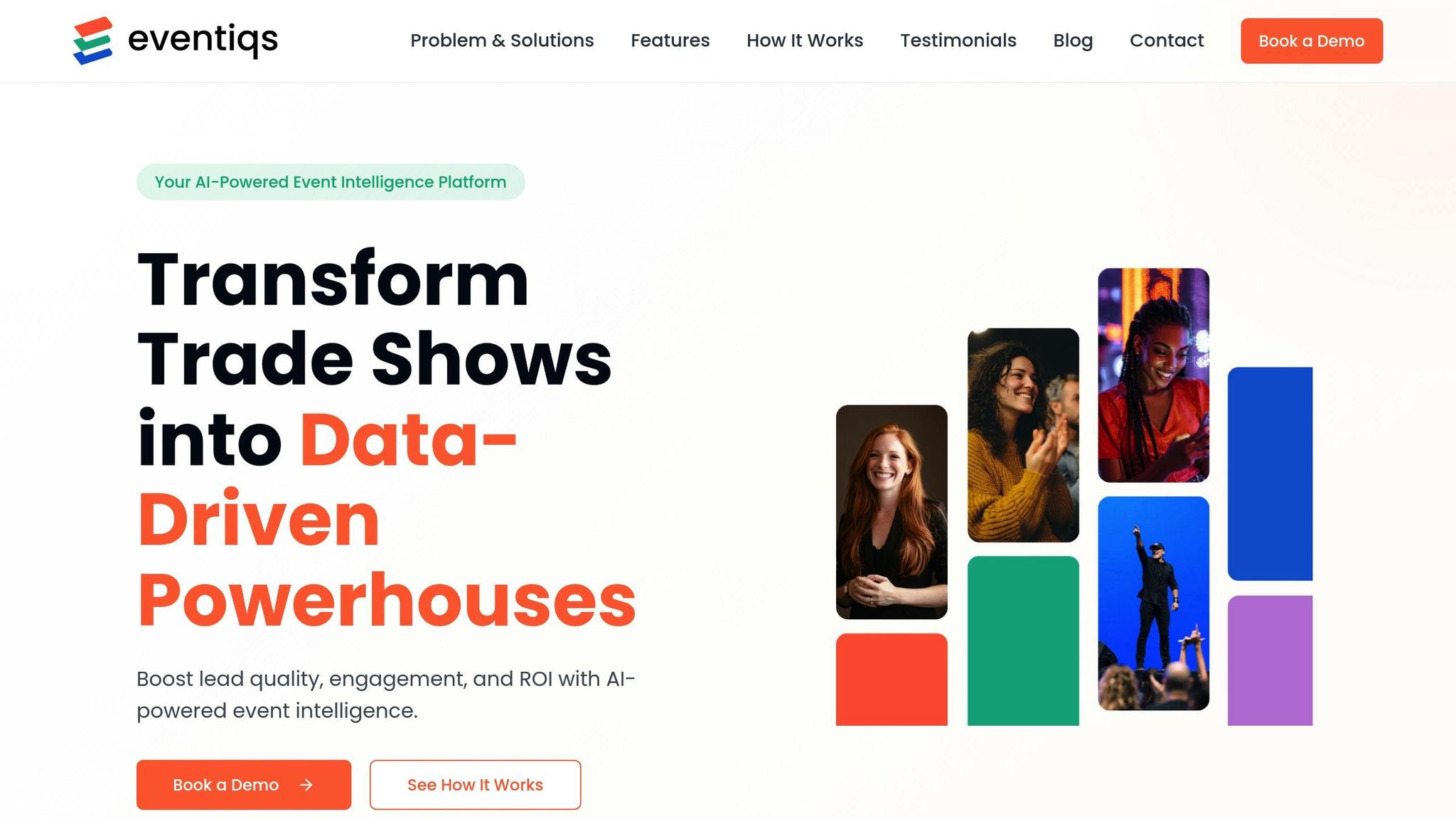
Eventiqs is a purpose-built AI platform tailored for trade show exhibitors. It blends predictive analytics with practical tools to boost visibility, generate better leads, and accurately measure ROI.
One standout feature is its AI-driven matchmaking system, which connects exhibitors with attendees who align with their ideal customer profile. By analyzing attendee data - such as profiles, interests, and behaviors - the platform identifies the most promising prospects, allowing exhibitors to focus their energy on high-value leads instead of casting a wide net.
Another key tool is real-time attendee interest mapping. This feature tracks how visitors interact with your booth, what content grabs their attention, and how long they spend in specific areas. These insights let you adapt your approach on the spot, ensuring you capture and maintain engagement throughout the event.
Automated lead scoring is another game-changer. By analyzing multiple data points, from registration details to live interactions, Eventiqs assigns scores to leads, helping your sales team prioritize follow-ups with the highest potential for conversion.
Eventiqs also enhances the overall trade show experience with tools like live polling for instant feedback, personalized attendee calendars for better planning, and networking features that encourage meaningful connections. Social media integration amplifies your event presence, making it easier to engage with a broader audience.
It Was Easy To Use And We Received Really Positive Feedback About The App From Our Attendees. Really Like The Interactive Schedule Feature. - Will Wray (Admin)
Features for Better Trade Show Performance
Eventiqs builds on its core capabilities with advanced analytics and seamless integrations, ensuring every aspect of your trade show strategy is covered.
The platform provides pre-event analytics to identify high-value leads, real-time metrics during the event for immediate adjustments, and post-event analytics to measure ROI and conversion rates. Heat mapping technology offers insights into attendee behavior, showing you where people spend the most time, so you can optimize booth layouts and staffing in real time.
Competitive intelligence tools give you a deeper understanding of industry trends and attendee preferences. By analyzing what draws visitors to other exhibitors, you can refine your approach and uncover new opportunities for engagement.
Eventiqs also ensures no lead slips through the cracks with multi-channel lead capture. Whether attendees share contact information digitally, scan business cards, or interact through the event app, all data is funneled into a centralized database. Customizable email templates make personalized follow-ups easy and efficient.
The platform’s export features allow you to transfer event data effortlessly for future use, while customizable branding ensures your presence remains consistent across all digital touchpoints. Additionally, Eventiqs works seamlessly across devices - PCs, laptops, tablets, and smartphones - ensuring your team can access critical tools whenever and wherever needed.
Integration with Event Tools
Eventiqs simplifies integration with existing tools, offering:
- CRM connectivity with platforms like Salesforce, HubSpot, and Microsoft Dynamics 365
- API integration for custom connections
- Native compatibility with popular event platforms
- Real-time data synchronization to ensure updates flow instantly across systems
This interconnected ecosystem eliminates manual data entry, reduces the risk of lost leads, and allows for swift responses to high-priority prospects. By maintaining compatibility with your marketing tools, Eventiqs supports both immediate trade show success and long-term relationship-building efforts.
Benefits of Predictive Analytics for Trade Show Exhibitors
Predictive analytics has become a game-changer for trade show exhibitors, helping to increase lead quality, boost engagement, and improve ROI. By leveraging data-driven strategies, companies can achieve measurable improvements that directly influence their revenue and planning.
Better Lead Quality and Conversion Rates
Predictive analytics can significantly enhance conversion rates, with some companies reporting up to a 25% increase - and in one case, a 45% jump - by focusing solely on high-potential leads. This technology examines a variety of data points, such as registration details, booth visits, social media activity, and past purchasing behavior, to identify attendees most likely to convert.
This targeted approach allows sales teams to channel their efforts into leads that matter most, cutting down the time spent on unqualified prospects by up to 50%. Unlike traditional lead scoring, machine learning continuously adapts and improves, becoming more precise with every interaction.
Increased Visibility and Engagement
With predictive insights, exhibitors can create tailored booth experiences that grab attention and hold it. By analyzing attendee preferences and behavior patterns ahead of time, exhibitors can customize their presentations, demos, and messaging to connect with their ideal audience.
Companies using these strategies report a 30% improvement in lead quality and a 25% decrease in lead acquisition costs. This success comes from understanding what drives attendee interest and optimizing booth tactics accordingly.
Personalization plays a big role here - 77% of buyers say they prefer tailored interactions. Predictive analytics enables exhibitors to craft personalized approaches by analyzing attendee profiles, interests, and past interactions. Real-time analytics further enhance engagement by allowing exhibitors to adjust their strategies during the event. For instance, if certain messaging resonates strongly with a specific audience segment, exhibitors can quickly shift their focus to capitalize on that insight.
Additionally, smart scheduling and matchmaking features connect exhibitors with the most relevant prospects. Some platforms have reported a 30% increase in meeting rates by using predictive algorithms to pair exhibitors with the right attendees.
Accurate ROI Measurement and Planning
One of the toughest challenges for trade show exhibitors is measuring ROI, especially with long sales cycles. Predictive analytics tackles this by using historical data - such as close rates and deal sizes - to forecast revenue from trade show leads, giving exhibitors a clearer picture of ROI even before deals are finalized.
When done right, trade shows can deliver a four-to-one ROI. Predictive analytics helps exhibitors hit these targets by optimizing every aspect of their event strategy. From tracking engagement across pre-show, during-show, and post-show activities to offering detailed performance insights, this technology ensures no opportunity is overlooked.
For example, one company saw a 40% increase in booth engagement while also generating more qualified leads by leveraging real-time predictive insights. Beyond individual events, predictive analytics helps exhibitors analyze trends across multiple shows, allowing them to identify which events yield the best returns, determine ideal booth sizes and locations, and refine engagement strategies. This transforms trade show participation into a data-backed, strategic effort rather than a guessing game.
Interestingly, exhibitors often miss out on up to 60% of potential leads simply because prospects never visit their booth. Predictive analytics addresses this issue by identifying high-value attendees ahead of time, enabling exhibitors to schedule meetings proactively with their most promising prospects.
If you think about outcomes and the outcomes you're trying to drive, you'll think about the data that really is valuable to you. - Mark Maydon, Commercial Director at CrowdConnected
Finally, predictive analytics fine-tunes follow-up strategies. By analyzing lead capture data and engagement levels, the technology helps prioritize follow-ups based on buying signals and intent. This ensures higher conversion rates while also shaping long-term event strategies for greater success.
Best Practices for Implementing Predictive Analytics at Trade Shows
To get the most out of predictive analytics at trade shows, it’s all about aligning technology, ensuring compliance, and preparing your team. Companies that implement these strategies effectively often see impressive results - think 35% higher lead conversion rates and 60% faster processing times. Once you’ve built a solid foundation, you can focus on training your team and fine-tuning your predictive models during the event.
Data Privacy and Compliance Requirements
Data privacy isn’t just about following the rules - it’s a way to build trust with your prospects. Trade show exhibitors often need to juggle regulations like GDPR (for international attendees) and CCPA (for California residents).
Here’s the difference: GDPR requires explicit consent before collecting personal data, while CCPA emphasizes transparency and gives consumers the right to opt out. Many exhibitors adopt GDPR standards across all their activities since it sets the strictest guidelines.
To stay compliant, use digital tools that clearly explain how you’ll use visitor data and ensure you’re capturing explicit consent. Many exhibitors rely on lead-management software to standardize practices across events.
Data minimization is key - only collect what you need. For instance, if your predictive models don’t require social media data, don’t ask for it. This approach reduces compliance risks and improves data quality. On top of that, implement strong encryption and access controls to meet enterprise security standards.
Regular audits are a must. They help identify compliance gaps and ensure you’re processing data deletion requests promptly, as required by both GDPR and CCPA. Once you’ve nailed compliance, your team can focus on turning analytics into actionable strategies.
Training Teams on Analytics Insights
Even the best predictive models won’t help if your team doesn’t know how to use the insights. Booth staff need to understand lead scores and turn them into meaningful conversations.
Start by assembling a cross-functional team that includes data scientists, sales experts, and tech professionals. This ensures your predictive models align with real-world sales strategies. For example, data scientists might identify valuable behavioral patterns, while sales pros know how to tailor conversations to different types of prospects.
Training should focus on behavioral signals that matter most. If a lead is flagged as high priority, your team needs to act fast. For example, a prospect who spent 15 minutes at your demo station and downloaded multiple whitepapers might need a detailed follow-up, while someone who just left their contact info might require a different approach.
During busy trade show hours, real-time decision-making is crucial. Train your team to monitor engagement patterns and adjust their approach on the spot. If analytics show that a particular message resonates with a certain audience, your booth staff should pivot immediately.
To streamline this process, set up automated alerts for your predictive models and integrate them with your marketing tools. This ensures insights flow smoothly from data collection to lead scoring to sales follow-ups.
Regular Updates and Real-Time Adjustments
Predictive models thrive on fresh data, so regular updates are essential for staying accurate. Companies that consistently refine their algorithms report 45% better follow-up efficiency and 50% fewer low-quality leads.
It’s smart to start with proof-of-concept tests at smaller events before rolling out predictive analytics at larger trade shows. This allows you to gather feedback and tweak your strategy without risking major opportunities. Experiment with different lead scoring criteria to see what drives the best results.
During the event, use A/B testing to adjust your campaigns in real time. For instance, if your analytics reveal that prospects engaging with interactive demos convert at higher rates, you can quickly allocate more staff to demo stations or rearrange your booth layout.
Keep an eye on sentiment analysis to understand how visitors are reacting. If certain questions or objections keep popping up, train your team to address these proactively in future conversations.
Maintaining data quality is an ongoing task. Regularly clean and validate your data to avoid inconsistencies. Focus on initiatives that will have the biggest impact instead of trying to implement every possible feature. Start by building detailed profiles based on real behavior, then expand your predictive capabilities gradually as your team becomes more confident with the technology.
The real magic happens with continuous refinement. After each trade show, analyze what worked and what didn’t. Use these insights to fine-tune your models for future events. Over time, this cycle of improvement will help you stay ahead of the game and ensure your analytics adapt to changing event dynamics.
The Future of Trade Show Success with Predictive Analytics
Predictive analytics is reshaping the way trade shows operate, turning what was once a guessing game into a strategy driven by data. In fact, 65% of senior executives attribute growth in 2025 to AI and predictive analytics, while 81% report that AI reduces manual tasks and improves conversion accuracy.
As costs rise and competition intensifies, traditional planning methods are no longer enough. Exhibitors now demand measurable ROI, pushing the industry toward innovations that are redefining trade show engagement.
Key Takeaways
The results speak for themselves: predictive analytics delivers real, measurable benefits that directly impact profitability. For example, data-driven lead generation improves lead quality by 30% and aligns sales and marketing efforts in 71% of companies. These aren't just incremental changes - they represent a fundamental shift in how exhibitors attract, engage, and convert prospects.
Eventiqs is a prime example of this transformation. Its AI-powered event intelligence platform offers tools like automated lead scoring, real-time attendee interest tracking, and detailed analytics. These features help exhibitors zero in on high-quality prospects while measuring ROI with precision. When combined with proper implementation - such as compliance measures, team training, and ongoing refinement - these tools provide a long-term competitive edge.
Personalization is another game-changer. With 77% of buyers preferring personalized experiences and 95% of B2B decisions influenced by tailored outreach, predictive analytics enables exhibitors to create highly targeted interactions. AI can analyze digital behaviors, engagement patterns, and company profiles to build dynamic customer profiles that evolve with market trends and conversion data.
Looking Ahead
The future of trade shows is brimming with potential, especially for early adopters of AI-powered tools. These technologies enable real-time personalization and decision-making, giving exhibitors a distinct advantage. Advanced analytics will soon allow businesses to track attendee behavior with even greater accuracy, optimizing their presence at future events.
One of the most exciting opportunities lies in real-time decision-making. Predictive analytics can identify peak traffic periods, key engagement moments, and top prospects by analyzing foot traffic, interaction data, and conversation trends. Over time, AI systems will become even smarter, reprioritizing leads on the fly based on behavior shifts, market dynamics, and sales team availability.
The urgency is clear in the numbers: with the average conversion rate for lead generation campaigns at just 2.35% and only 25% of leads deemed qualified to buy, relying on intuition alone is no longer an option. Predictive analytics uncovers subtle buying signals across digital touchpoints, assigning comprehensive lead value scores that factor in deal size, sales cycles, and customer lifetime value.
But success requires more than adopting new technology. It demands a focus on data accuracy, thorough team training, and a commitment to ongoing optimization. Companies that take this approach will be well-positioned to leverage emerging trends like conversational AI, automated lead qualification, and cross-channel attribution. The future belongs to those who can transform data into actionable insights - and turn those insights into lasting relationships.
FAQs
Q: How does predictive analytics help improve lead targeting and conversions at trade shows?
Predictive analytics takes the guesswork out of lead targeting at trade shows by leveraging data to pinpoint and prioritize the most promising prospects. By examining attendee behavior, preferences, and engagement trends, it helps exhibitors zero in on the leads most likely to turn into customers.
This method allows for tailored outreach, smarter use of resources, and more effective follow-up plans, often boosting conversion rates and maximizing ROI. Adding predictive tools to your trade show playbook can lead to stronger connections and better results across the board.
Q: What data is essential for using predictive analytics to improve trade show lead strategies?
To make the most of predictive analytics at trade shows, you’ll need essential data sources such as historical event performance, attendee demographics, engagement metrics, booth traffic patterns, lead quality, survey feedback, and behavioral insights. These data points are the foundation for predicting attendee behavior and fine-tuning your strategies.
With this information, you can pinpoint promising leads, customize your outreach, and get the best return on your trade show investment. Having accurate data ensures you make informed decisions that align with what attendees are looking for.
Q: How does real-time predictive scoring help prioritize the best leads during a trade show?
Real-Time Predictive Scoring: A Game Changer for Lead Prioritization
Real-time predictive scoring takes the guesswork out of lead prioritization by analyzing attendee data on the spot. It ranks prospects based on their potential value, giving sales teams a clear picture of where to focus their energy during the event. The result? A sharper, more efficient approach to engaging with high-potential leads.
This tool doesn’t just stop at ranking - it uses real-time insights, like attendee engagement and behavior, to help you fine-tune your strategy on the fly. By adapting your approach in real time, you can turn raw data into actionable opportunities and make the most of your trade show investment.