Speed networking at corporate events: dealer meetings, onboarding and cross-team introductions
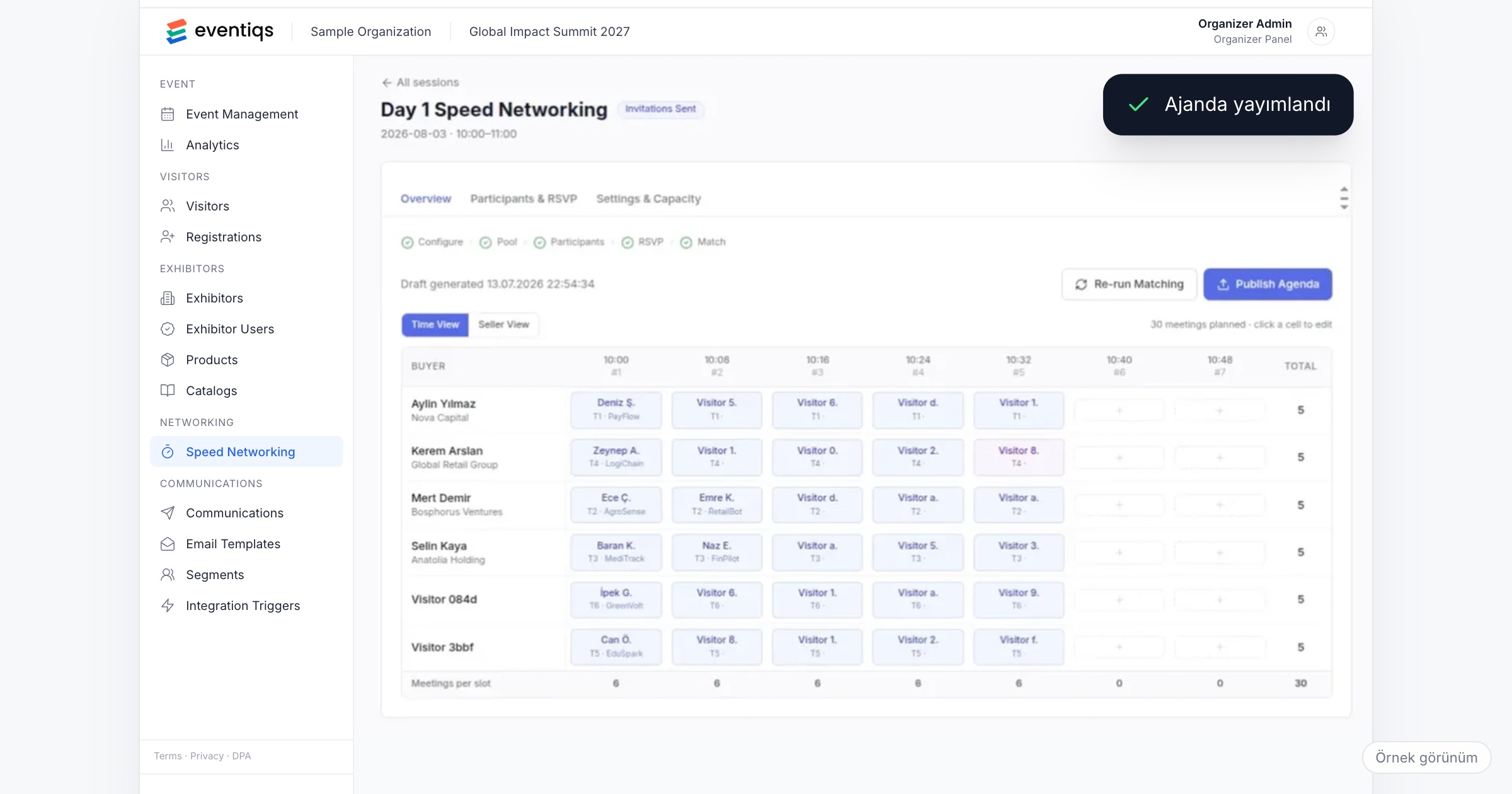
Corporate speed networking is a planned session inside a company event in which invited people meet in short, timed rounds at numbered tables, with each pairing decided in advance: dealers with regional managers, new hires with team leads, two merged teams with each other. It suits closed events because the organizer already knows who will be in the room and who should meet whom, so the rounds can be built from that knowledge instead of left to chance. When you plan one, check how invitations and RSVPs are handled, whether each person's table and time reach their calendar, how check-in works at the session, and whether you get feedback on every meeting afterwards.
Why speed networking inside a company is different
At an open conference, speed networking introduces strangers. Inside a company the goal is narrower and the expectations are different. A few typical scenes:
- Dealer meetings. At a meeting of 300 dealers, every dealer should sit with their regional manager and with two or three product teams. Left to open requests, the popular teams are booked out and some dealers see no one.
- Onboarding and new-hire days. Thirty new hires meet the leads of the teams they will work with, eight minutes each, before the afternoon training. Speed networking for employees rarely gets a more natural setting than this.
- After a merger or reorganization. Two teams that now share targets know each other only from an org chart. Short rounds across the old company lines start conversations that a town hall cannot.
- Partner and supplier days. Each supplier gets time with procurement, quality and logistics in one sitting, instead of three separate visits.
- Mentoring rounds. Junior staff rotate among senior colleagues, with pairs set from what each mentee wants to learn.
What these scenes share: the guest list is closed, the matching rule comes from the company's own structure (region, function, team), and attendance is often expected rather than optional. That makes planning easier in one way, because you know everyone, and harder in another, because people who were sent by their manager do not always answer invitations.
How to plan a corporate speed networking session
1. Round length and table math
A round is the meeting time plus the time it takes to change tables. A dealer talking to a regional manager needs longer than two new hires saying hello: think of 10 to 12 minutes for a dealer meeting and 6 to 8 for introductions. Multiply tables by rounds to get the total number of meetings, then check each person's count against what you promised them. Our speed networking guide works through the formulas with an example.
2. Pairs or small groups
One-to-one pairs suit dealer meetings and mentoring, where each conversation is about one person's situation. A small group at a table (one manager, three dealers) suits cases where the scarce side cannot meet everyone individually, or where new hires are more at ease in a group. Groups reach more people per round but give each person less time to speak, so decide by what the meeting is for.
Ask the vendor: Can the match matrix be edited by hand after it is generated? Can matching be re-run when the participant list changes?
3. Invitations with RSVP questions and a deadline
Send the session invitation separately from the event invitation, and use it to ask what you need to build the rounds: "Which product lines do you want to discuss?", "Which region do you cover?". Set a deadline and track the answers until then. A dealer who has not replied two days before the session is a phone call to make, not an empty table on the day.
Ask the vendor: Can we add our own questions to the invitation? Can we see who has answered before the deadline?
4. Matching from your own structure
Inside a company you rarely have to guess; the rule usually comes from the org chart. Every dealer meets their own regional manager, every new hire meets the leads of their future team, and people from two merged teams meet across the old line, not within it. Build the matrix from that rule, then check it by hand: no one meets the same person twice, no one sits out several rounds in a row, and no two dealers from competing regions share a group table.
5. The agenda in each person's calendar
Once the matrix is ready, publish it so that each person sees their own table, time and partner in the same calendar that holds the rest of their program. A printed sheet handed out at the door gets lost; the calendar is where people already look for what comes next.
6. Check-in at the session
Check-in tells you who is actually in the room before the first round. Scanning a session QR code with the app is quick enough not to hold up the start, and it gives you a reliable list to rework the rounds from when someone is missing.
Ask the vendor: When does check-in open? What happens to a participant's rounds when the person they were meant to meet does not check in?
7. Feedback after every meeting
Ask three things right after each meeting: did it happen, how useful was it on a scale of 1 to 5, and do you want to follow up? The answers are short enough that people give them, and they tell you more than a survey sent a week later.
8. Using the feedback for follow-ups and the next edition
The follow-up answers are your to-do list for the weeks after the event: a dealer who asked to follow up with the logistics team should hear from logistics. Low ratings for one kind of pairing (dealers and marketing, say) tell you to change the mix next time. Meetings marked as not held show where the room layout or the timing let people down.
Checklist before the session
- Write the purpose of the session in one sentence: who must meet whom, and why.
- Decide the round length, the number of tables, and pairs or groups.
- Send invitations with RSVP questions and a clear deadline.
- Build the matrix from your structure, then check it by hand.
- Publish the agenda so it reaches each person's calendar before the day.
- Set up the room: numbered tables, a visible timer and the session QR code at the entrance.
- Brief the hosts on what to do about no-shows and late arrivals.
- Decide who reads the feedback and who owns the follow-ups.
Common mistakes
- Treating attendance as certain. Even people sent by the company do not all turn up; without RSVPs and check-in, tables stand empty.
- Using one round length for every audience. A dealer with a pricing question needs more time than two new hires introducing themselves.
- Letting the scarce side be overbooked. If every dealer can pick the sales director, the matrix falls apart; set the rule from your structure.
- Publishing the agenda only on paper. People who cannot find their table lose the first round.
- Collecting feedback and not reading it. Follow-up requests that nobody acts on teach people not to answer next time.
How Eventiqs helps
The Speed Networking module in Eventiqs runs these sessions in the same app as the program, matching and messaging. The organizer sets the date, time, round length and number of tables, chooses who joins, and sends invitations with optional RSVP questions, tracking the answers until a deadline. The match matrix is laid out by round, table and time; it can be edited cell by cell, and matching can be re-run. Publishing the agenda puts each participant's table, time and partner in their calendar. Participants check in by scanning the session QR code with the app, and check-in opens 30 minutes before the start. After each meeting they say whether it happened, can rate it from 1 to 5 and mark whether they want to follow up. For open meetings around the session, read networking at corporate events; for the planning math, see the speed networking guide.