Why organizers need to use AI powered matchmaking tools for event success?

Why organizers need to use AI powered matchmaking tools for event success?
AI-powered matchmaking tools are transforming event networking by making connections more intentional, efficient, and measurable. Here's why event organizers should prioritize these tools:
- Better Networking: AI matches attendees based on shared interests, goals, and behavior, eliminating the randomness of traditional methods.
- Higher ROI: Events using AI see up to a 214% ROI and significant increases in qualified leads and engagement rates.
- Time-Saving Automation: AI automates scheduling, lead scoring, and follow-ups, reducing manual work and improving efficiency.
- Data-Driven Insights: Organizers gain actionable analytics to measure success, adjust strategies, and improve future events.
With attendees prioritizing meaningful connections, AI matchmaking tools like Eventiqs ensure event success by focusing on precision, personalization, and measurable outcomes.
We are Grip, the AI-powered event, matchmaking and networking platform
Problems with Traditional Event Networking
Even though AI is reshaping the event industry, traditional networking methods still pose significant challenges. While 77% of trade show attendees consider networking a top priority [4], these older approaches often fall short, leading to missed opportunities, inefficiencies, and a lack of actionable insights.
Missed Buyer-Seller Connections
Traditional networking at events often depends on chance meetings, pre-scheduled appointments, or casual social gatherings that lack a structured matchmaking system [3]. This randomness is problematic, especially when companies report an average ROI of $4 for every $1 spent on trade shows, with networking being a key driver of that return [4]. With hundreds of booths and sessions competing for attention, it’s easy for attendees to miss valuable connections. Even when meaningful interactions occur, poor follow-up practices further reduce the potential for long-term benefits [3] [4].
Inefficient Manual Matchmaking
Relying on outdated methods like exchanging business cards or relying on chance encounters is not only slow but also ineffective. Only 38% of these connections typically evolve into lasting relationships [7] [8], and 60% of leads are never followed up on [6]. For large events spanning multiple industries or niches, the lack of personalized matchmaking becomes even more evident [7]. Manual processes simply can’t manage or analyze the vast data needed to make tailored recommendations [7], nor can they adapt in real time to changing attendee preferences [5]. This inefficiency results in missed opportunities and lower returns on investment [7].
As industry leaders point out, these issues demand attention. Julius Solaris emphasizes:
Connection is the name of the event game in the '20s. You can't leave connection to chance. Attendees are craving more opportunities to network. Not as easy as you think. Events need to think networking first to win these days. [6]
Christine Renaud, CEO of Braindate, echoes this sentiment:
The concept of 'networking' itself leads to an empty shell... Most 'networking sessions' don't come even close to creating the right context for these buds of true relationships to emerge. It takes much more than some funky cocktails and clever name tags: it requires the creation of a culture of psychological safety, care and belonging. [6]
Lack of Data and Metrics
Traditional networking methods also fail to provide event organizers with actionable insights. Many trade shows still rely on outdated directories and manual processes, which don’t align with the expectations of modern participants [4]. Without data, organizers can’t effectively measure success or improve future events. For instance, they struggle to:
- Track which connections led to tangible business results
- Analyze attendee preferences and behaviors
- Measure the ROI of networking activities
- Pinpoint areas for improvement in upcoming events
This lack of data-driven insights leads to generic, one-size-fits-all networking experiences [3]. Moreover, post-event follow-ups often rely on manual processes, resulting in missed opportunities and disjointed communication [3]. Without systems to collect and analyze data, organizers are left guessing, making it harder to enhance the networking experience at future events.
How AI-Powered Matchmaking Tools Fix These Problems
AI-powered matchmaking tools like Eventiqs are transforming the way networking happens at events by tackling the common challenges of traditional methods. Using advanced algorithms and real-time data analysis, these platforms help create meaningful connections, streamline networking processes, and provide actionable insights that lead to measurable outcomes.
Personalized Connection Recommendations
AI matchmaking tools dive deep into attendee data - such as registration details, job titles, industries, interests, and even social media profiles - to create detailed attendee profiles. From there, they identify shared interests and event-related content that align with these profiles, suggesting connections that are highly relevant. These tools also track user behavior, including page views, exhibitor interactions, product preferences, and meeting requests. Filters like job title, location, company size, and budget further refine these suggestions for precision [9].
This level of personalization mirrors the success of consumer platforms. For example, McKinsey reports that algorithm-driven recommendations influence 35% of all purchases on Amazon and 75% of content watched on Netflix [11]. In the same way, AI matchmaking in B2B events ensures attendees connect over shared business goals. McNeel Keenan, Vice President of Product Management at Cvent, captures this potential perfectly:
AI-driven personalization will be a game-changer for the meeting industry, allowing attendees to experience highly tailored content, sessions and networking opportunities, all based on their unique preferences and behaviors. [12]
By aligning interests, goals, and industry relevance, these tools make networking more intentional and meaningful [10]. And the benefits don’t end there - automation takes the convenience even further.
Automated Networking Processes
AI tools take the hassle out of networking by automating processes like matchmaking, scheduling, and lead qualification. They analyze attendee data to not only recommend connections but also suggest the best times and locations for meetings during the event [1].
This automation boosts meeting acceptance rates and simplifies scheduling, making events more efficient. Additionally, these platforms provide real-time analytics to track attendee preferences and behaviors, allowing organizers to make adjustments on the fly and review detailed engagement insights after the event [13][14]. As Pauliina Alanen, Comms & Marketing Lead at Silo.AI, explains:
AI-powered matchmaking can understand this complex phenomenon by going beyond keywords or titles and focusing on a deeper level – intents based on user's past behavior. [2]
Data-Driven Performance Insights
AI tools don’t just connect attendees - they also give organizers powerful analytics to improve event performance. By combining data from event apps, registration systems, social media, and attendee interactions, these platforms provide insights that help organizers make real-time adjustments to content, schedules, and networking opportunities. For instance, Google I/O fine-tuned its session content based on live feedback [16].
The results speak for themselves. Eventico Technologies reported a 20% rise in attendee satisfaction and cut event management costs by 30%. ConferLink saw a 50% uptick in networking activity and a 35% boost in satisfaction scores. Meanwhile, FestiTech improved crowd management by 60% and increased attendee engagement by over 45% [15].
Predictive analytics take it a step further, helping organizers anticipate trends and challenges. SXSW, for example, used attendance projections to optimize its resources [16]. Sentiment analysis - evaluating feedback, social media posts, and surveys - along with detailed post-event reports, helps shape better decisions for future events.
AI-powered recovery tools also re-engage potential participants, with automated follow-ups increasing registrations by as much as 22%. Additionally, AI assistants handle up to 80% of routine queries, freeing up staff to focus on more critical tasks [18]. Jeff Moore, Vice President of Technology and Innovation at MCI USA, summed it up well:
Embracing data-driven decisions is no longer optional; it's essential for future-focused event planning. [17]
Main Benefits of Using Eventiqs for AI Matchmaking
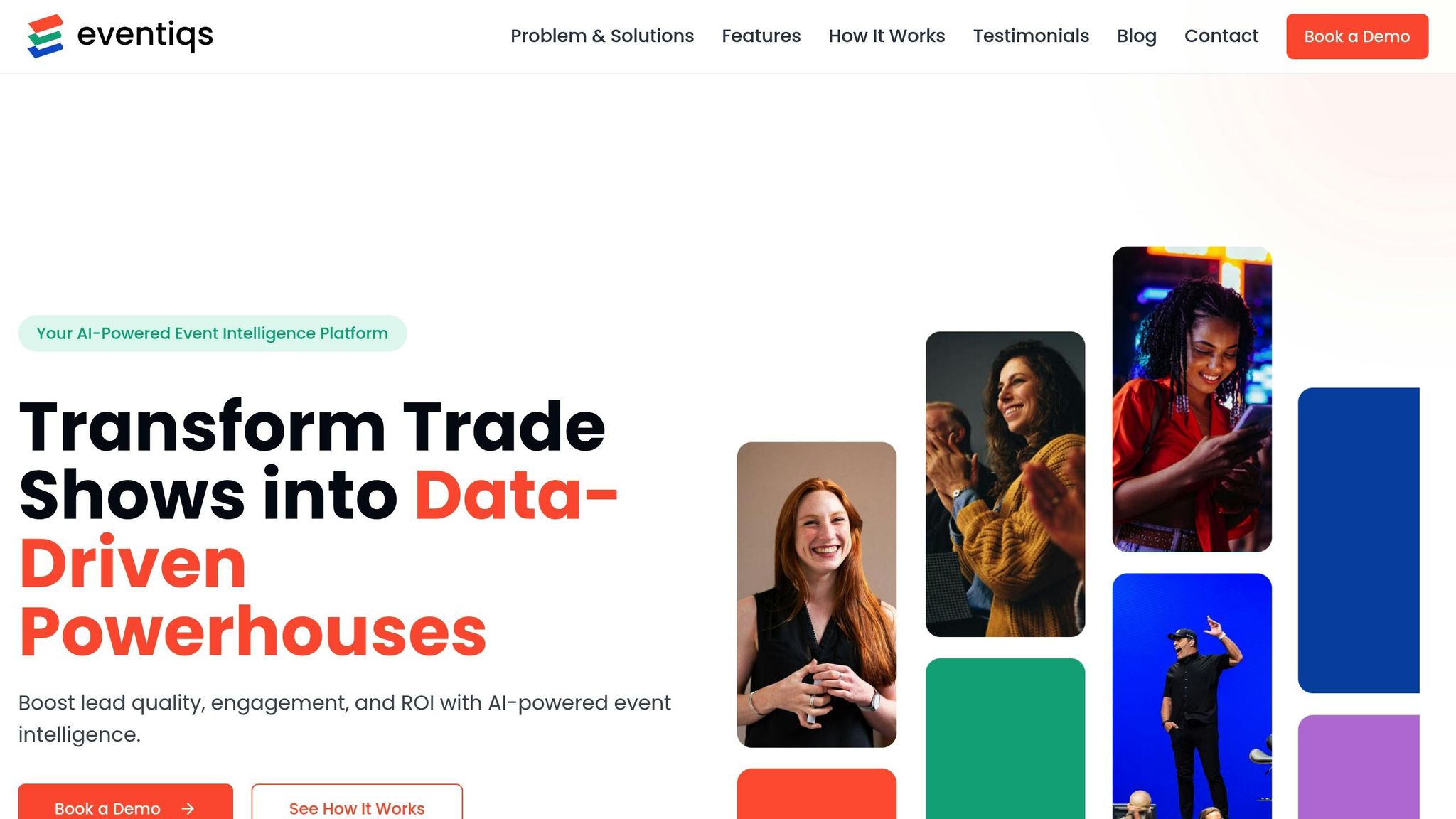
Eventiqs is reshaping the event experience by tackling key challenges in networking and delivering measurable results for organizers and exhibitors. With its AI-powered tools, the platform improves networking efficiency, boosts attendee engagement, and enhances post-event performance.
Better Buyer-Seller Connections
Eventiqs eliminates missed opportunities and streamlines manual processes by leveraging its advanced AI recommendation engine and automated lead scoring system. By analyzing attendee data, the platform connects exhibitors with the most relevant prospects, while intelligent follow-up tools help turn these connections into long-term business relationships.
The results speak for themselves: clients report a 147% increase in qualified leads, conversion rates 3.4 times higher than the industry average, a 68% drop in cost per acquisition, and a 214% average ROI on trade show investments [19]. Sarah Johnson, Marketing Director at TechSolutions Inc., shared her experience:
Eventiqs transformed our trade show strategy. We saw a 43% increase in qualified leads and finally have clear ROI metrics for our events. [19]
Additionally, Eventiqs offers AI-based booth placement recommendations, which can be a game changer for smaller exhibitors. Michael Chen, CEO of Innovate Systems, noted:
As a smaller exhibitor, we always struggled to stand out. With Eventiqs' AI recommendations, we optimized our placement and saw 2X the booth traffic. [19]
The platform also delivers 75% higher lead quality on the final day of trade shows compared to traditional methods [19].
Improved Attendee Experience and Engagement
Eventiqs enhances the attendee experience by providing personalized recommendations tailored to individual interests and business goals. This ensures that visitors connect with companies that align with their needs, making their time at the event more productive.
Organizers and exhibitors also benefit from real-time data visualization through the Event Intelligence Command Center. This tool allows for immediate adjustments and strategic decisions based on evolving attendee behavior, ensuring everyone stays ahead of the curve.
Complete Post-Event Analytics
Eventiqs doesn't just stop at live interactions; it delivers powerful post-event insights to help organizers measure ROI and refine future strategies. The platform's analytics dashboard offers detailed metrics on lead quality, engagement, and conversions - data that was once difficult to access.
Aisha Patel, Head of Events at GlobalTech Solutions, highlighted the impact:
The analytics dashboard is a game changer. For the first time, we can see exactly which strategies drove the most value at our trade shows. [19]
Her team achieved a 68% improvement in follow-up conversions thanks to these insights [19]. By turning data into actionable strategies, Eventiqs helps organizers continuously improve their events and sustain long-term success.
Conclusion: Using AI for Better Event Results
Traditional networking methods are being outpaced by the efficiency and precision of AI-powered solutions. Event organizers adopting these technologies today are setting themselves up for success in an increasingly competitive landscape. As we've explored, AI reshapes the way connections are made by making networking more personal, immediate, and measurable. This shift toward AI-driven approaches is redefining what event networking can achieve.
The Future of Event Networking
AI-powered matchmaking has quickly become a cornerstone for successful events. With 84% of attendees prioritizing networking and 77.7% of business professionals believing in-person conferences provide the best opportunities for meaningful connections, the stakes for organizers to deliver exceptional networking experiences are higher than ever [22].
AI is revolutionizing the event industry by providing insights that were previously unattainable. It's no longer about just counting attendees; it's about understanding their behavior and preferences in real time. - Michelle Greene, Event Strategist and Founder of Event AI Solutions [21]
Events leveraging AI matchmaking consistently report acceptance rates between 31% and 39%, showcasing the scalable impact of these tools. Organizers who invest in AI now will stay ahead of the competition by offering enhanced attendee experiences and measurable returns on investment, while those who delay risk falling behind.
Key Points for Event Organizers
AI offers event organizers a range of advantages that go far beyond traditional methods. It eliminates much of the manual guesswork, replacing it with precise, actionable data [21].
Data is the backbone of modern event planning, and AI is the spine that holds it all together. By leveraging AI, event organizers can make smarter decisions, optimize experiences, and measure ROI with precision. - John Montgomery, Chief Data Officer at NextGen Events [21]
From a financial perspective, the benefits are equally compelling. AI enables organizers to maximize sponsor investments by connecting them with the right audience, while also boosting revenue through higher attendee satisfaction and increased repeat attendance [20]. Operational costs are reduced as AI streamlines processes, freeing up staff to focus on strategic tasks rather than manual coordination.
AI also creates a long-term competitive edge. With every event, the system refines its matchmaking capabilities using accumulated data, leading to better connections and more satisfied attendees. This positive cycle enhances the overall value of events, attracting higher-quality participants and delivering even greater results.
FAQs
Q: How do AI-powered matchmaking tools make networking at events more effective than traditional methods?
AI-powered matchmaking tools are changing the way people network at events by pairing attendees automatically based on their shared interests, professional expertise, and potential for collaboration. Instead of leaving connections to chance or relying on manual introductions, these tools use advanced algorithms to analyze attendee profiles, session preferences, and even past interactions to suggest the most relevant matches.
This smarter approach not only saves time but also leads to more meaningful conversations and stronger engagement. By offering personalized recommendations and streamlining the process of scheduling meetings, these tools ensure attendees and organizers get the most out of their event experience.
Q: What valuable insights can event organizers gain from AI matchmaking tools, and how do these insights improve future events?
AI matchmaking tools equip event organizers with valuable insights about attendee engagement, networking trends, and session preferences. This information allows organizers to pinpoint which connections worked well, identify sessions that left a strong impression, and uncover areas needing improvement.
With these insights, organizers can craft tailored agendas, improve networking opportunities, and even anticipate attendee behavior for upcoming events. The result? Happier attendees, smoother planning, and more effective marketing strategies - all contributing to better ROI and more memorable event experiences.
Q: How do AI-powered matchmaking tools boost ROI for event organizers and exhibitors?
AI-powered matchmaking tools take networking to the next level by using advanced algorithms and attendee data to create highly tailored connections. These tools dig into attendee preferences, behaviors, and intentions to pair exhibitors with the most relevant prospects. This means less time wasted on cold outreach and more focus on high-value leads.
By zeroing in on the right connections, these tools make networking smoother, speed up the sales cycle, and boost engagement. The result? Higher conversion rates. Plus, automating these processes saves time, improves efficiency, and helps organizers and exhibitors get the most out of their investment.